
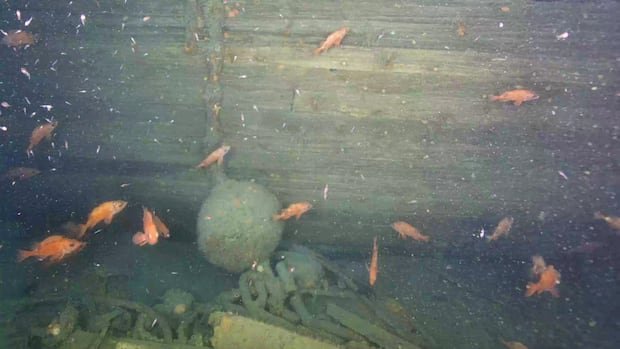
An exploration deep in the Labrador Sea, nearly 400 meters below the surface, is uncovering the initial visuals of the Quest, the vessel that carried the renowned Antarctic explorer Sir Ernest Shackleton on his final journey. The Royal Canadian Geographical Society (RCGS) deployed a remotely operated vehicle (ROV) to capture images of the sunken ship off the Labrador coast in 1962.
CBC News had exclusive access to the expedition onboard the research ship Atlantis, where the first images revealed the rear part of the exploration vessel entangled in fishing gear. “It’s a concerning sight,” expressed David Mearns, a co-chief scientist on the expedition with extensive experience in shipwreck discovery.
Mearns expressed worry over the potential damage caused by the fishing nets, stating that the wreck might have suffered more from the entanglement than if left undisturbed on the ocean floor. The initial discovery of the Quest wreck was made by RCGS using side-scan sonar technology two years ago.
The expedition, one of the largest undertaken by the society, comes with a significant cost in the millions of dollars. The RCGS collaborated with the Woods Hole Oceanographic Institution from Massachusetts, utilizing their vessel and submersible to investigate two shipwrecks in the Labrador Sea.
During the exploration, John Geiger, CEO of RCGS, and the expedition leader, descended in the submersible Alvin for the first dive to the wreck. Geiger shared a poignant moment witnessing the emergence of the ship’s bow from the darkness, reflecting on Shackleton’s legacy and the historical significance of the vessel.
Originally acquired by Shackleton for exploration in Northern Canada, the Quest was diverted to Antarctic expeditions when the Canadian government declined support. Shackleton tragically passed away from a heart attack aboard the ship near South Georgia in 1922.
After serving as a minesweeper during World War II and for seal hunting by a Norwegian company, the Quest met its demise in 1962 off Labrador’s southern coast due to hull-crushing ice. Although the crew survived, the ship lost its cargo of thousands of seal pelts in the sinking.
Despite the damage caused by trawl fishing, the research director affirmed the wreck’s identification as the Quest through distinctive features matching historical records. The expedition aims to digitally recreate the wreck using advanced imaging technology, shedding light on the vessel’s condition and surrounding debris field.
Following their investigation of the Quest, the expedition plans to explore another wreck, Terra Nova, located near the southern tip of Greenland. This vessel was famously utilized by Robert Falcon Scott in his ill-fated 1912 expedition to the South Pole.

