
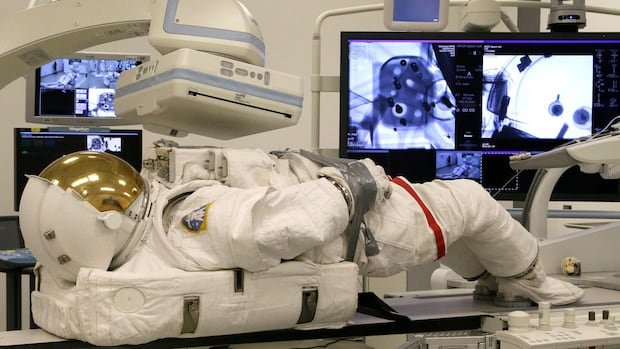
Researchers anticipate that deep space exploration will drive new advancements in healthcare systems on Earth, with a focus on portable medical technology and robotic care. These innovations are expected to offer significant benefits, especially to remote and under-resourced communities.
Dr. Dave Williams, a former ER doctor and astronaut based in Toronto, highlights the potential for applying lessons learned from lunar habitats to improve remote medical care in locations like northern Canada.
Dr. Farhan Asrar, an associate dean at Toronto Metropolitan University’s school of medicine, along with other experts, is studying potential health-care innovations related to upcoming deep-space missions to the Moon and eventually Mars.
As missions into deep space become longer and farther away, the need for faster communication technologies to enable virtual care becomes crucial. Additionally, advancements in robot- and AI-supported care are expected to play a key role in providing timely healthcare to astronauts in space.
The development of wearable technology for vital sign monitoring, robotic limbs, and exoskeletons is also anticipated to progress, offering support to individuals at risk of falling or those with disabilities.
The relationship between space medicine and terrestrial medicine is symbiotic, as innovations in one field often drive developments in the other. Portable medical technology is becoming increasingly vital in space, where heavy equipment is impractical, and such advancements can also benefit physicians in remote communities and disaster-affected areas on Earth.
Limited resources and challenges with medical access in remote communities necessitate innovative solutions, similar to those required in space missions. The parallels between providing healthcare in isolated regions on Earth and in space are evident, underscoring the importance of adaptable medical technologies.
Space medical innovations often find applications on Earth after rigorous testing, contributing to advancements in healthcare systems worldwide. Organizations like the Canadian Space Agency prioritize technologies that offer benefits both in space and on Earth when allocating funding for research and development.
While innovations in robotics and automated healthcare are progressing, challenges such as costs and regulatory processes can delay their implementation on Earth. However, successful space missions like Artemis II are expected to accelerate innovation in the healthcare sector, leading to increased interest in aerospace medicine and attracting more professionals to the field.

