
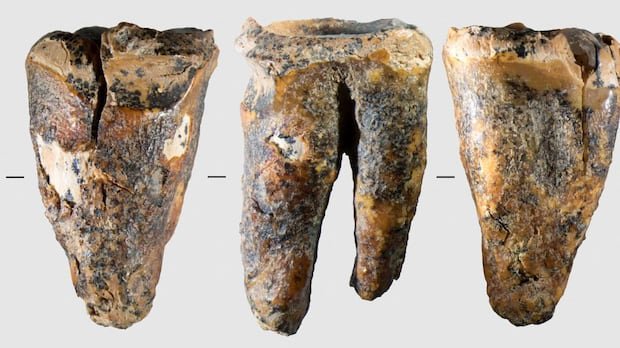
About 59,000 years ago, a Neanderthal in Siberia experienced a severe tooth issue and took action to address it. Recent findings reveal a lower molar in the Altai Mountains exhibiting signs of early dental work, where a large hole was manually drilled with a stone tool to remove decay. This discovery, detailed in a study published in the journal PLOS One, marks the earliest known instance of invasive dental surgery, predating Homo sapiens’ dental practices.
Anthropologist John Olsen, a study co-author, speculates on how a Neanderthal with a toothache sought relief. He suggests that the individual either sought external help due to extreme pain or attempted self-treatment by utilizing a stone drill. The former scenario aligns with Neanderthals’ social nature, indicating a willingness to seek assistance when needed.
While the existence of specialized Neanderthal dentists is uncertain, the precision of the dental intervention implies a skilled practitioner conducted the procedure. The adult Neanderthal from Chagyrskaya Cave in Russia, where the tooth was found, likely received deliberate and well-executed treatment for the tooth issue.
The study’s findings challenge prior beliefs about Neanderthals’ capabilities, highlighting their cognitive skills in planning and executing complex tasks like dental surgery. This revelation underscores the sophistication of Neanderthals’ medical strategies and their ability to understand and address health issues effectively.
Neanderthals, often portrayed as primitive in popular culture, have been proven to engage in various complex activities like art creation, tool crafting, and even medical care. The recent tooth study emphasizes not only Neanderthals’ potential medical expertise but also their advanced communication abilities in conveying complex concepts like enduring short-term pain for long-term benefits.
The research sheds light on the evolving understanding of Neanderthals’ intelligence and societal dynamics, challenging outdated perceptions of these ancient human relatives. The tooth discovery serves as a testament to Neanderthals’ advanced cognitive capacities and their ability to engage in sophisticated medical practices thousands of years ago.

