
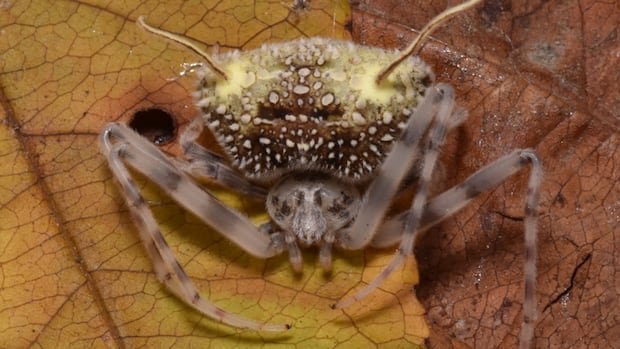
In a surprising turn of events during an August 2025 group tour in the Amazon rainforest, scientist Alexander Bentley encountered a spider seemingly alive beneath a mass covered in what appeared to be a deadly parasitic fungus. Bentley, a herpetologist based in Ecuador, is familiar with cordyceps, a parasitic fungus known for its role in the post-apocalyptic franchise “The Last of Us.”
Cordyceps, also referred to as “zombie fungus,” infects insects and arachnids, manipulating them to spread its spores in a zombie-like manner, as documented by the National Library of Medicine. Initially, Bentley believed the spider he found was a victim of cordyceps, indicated by the presence of tubercles on its abdomen—a common sign of cordyceps infestation.
To Bentley’s surprise, further investigation revealed that the spider belonged to a new species that mimics fungus like cordyceps, a behavior possibly used for hunting or defense. This groundbreaking discovery was detailed in a publication by Zootaxa. While scientists celebrate this find, some remain skeptical about the spider’s resemblance to the fungus.
Utilizing the citizen-science platform iNaturalist, Bentley sought input regarding the spider’s unusual features. Contrary to initial assumptions, specialists confirmed that the spider was not infected with fungus but rather a previously unidentified species named Taczanowskia waska.
Through meticulous analysis of the spider’s morphology, co-author David Ricardo Díaz-Guevara validated the classification of this new species. The unique characteristics of this spider have captivated experts like mycologist Monika Fischer, emphasizing the significance of citizen science platforms.
Two prevailing theories suggest that the spider’s fungus-like appearance may serve as either an aggressive hunting strategy or a defensive tactic against predators. While the purpose of this mimicry remains open to interpretation, experts like Andrew Swafford acknowledge the unprecedented nature of this discovery.
Bentley regards this finding as one of the most remarkable encounters in his rainforest explorations, highlighting the rarity and uniqueness of the Taczanowskia waska spider. The implications of this discovery extend beyond conventional scientific understanding, marking a significant milestone in arachnid research.

