
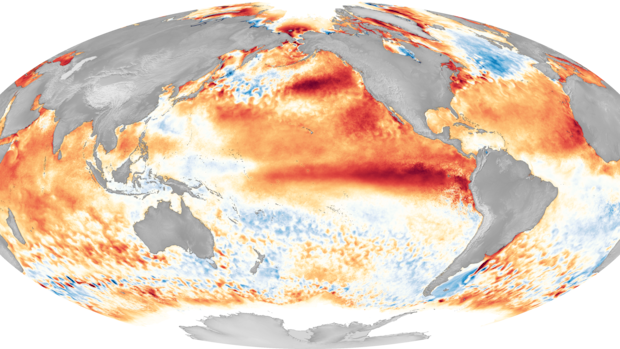
After experiencing La Niña conditions for the past 18 months, indicators now suggest that an El Niño event could materialize later this year. Initial forecasts indicate a potentially robust El Niño pattern, likely leading to a surge in global temperatures. La Niña and El Niño are integral components of the El Niño Southern Oscillation (ENSO), a natural cyclical phenomenon within the Pacific Ocean.
La Niña typically results in cooler temperatures in the Niño 3.4 region of the ocean, while El Niño brings warmer conditions. These variations in ocean temperatures have widespread implications, influencing climate patterns globally, leading to floods in some areas and droughts in others, while also impacting overall temperatures.
Presently, a La Niña advisory/El Niño watch is in effect, with the Climate Prediction Center of the National Oceanic and Atmospheric Administration (NOAA) anticipating a transition towards El Niño by summer after a period of neutral conditions. Recent assessments by Zeke Hausfather from Berkeley Earth highlight that multiple models project a high probability of a strong or even “super” El Niño event occurring later this year, indicating a significant departure from previous forecasts.
Notable El Niño events in recent history, such as those in 1997-98 and 2015-16, have had substantial impacts. The 1997-98 event, characterized as a super El Niño, saw temperatures in the Niño 3.4 region rise approximately 2.7 degrees Celsius above average, while the 2015-16 event was classified as strong, with temperatures exceeding 2 degrees Celsius above average.
Currently, the combined forecast from Hausfather’s analysis suggests a 2.4 degrees Celsius temperature anomaly. However, these projections are still considered preliminary, subject to the “spring unpredictability barrier,” which limits their reliability. Climate scientist Daniel Swain, from the University of California Agriculture and Natural Resources, corroborates the likelihood of a potent El Niño, with most models indicating a trend towards moderate to strong intensity by the latter part of summer.
The potential impacts of a strong El Niño extend beyond temperature increases, affecting regional weather phenomena. Forecasts indicate a probable El Niño development around June, varying across models, with a peak forecasted for November. While 2027 is on track to be among the warmest years recorded, the full influence of El Niño may not manifest until later due to a typical lag of approximately three months post-peak.
Despite the predictive models, the unpredictability of the climate system remains a challenge, as evidenced by the unexpected outcomes following the 2023-2024 El Niño. The scientific community continues to monitor these developments closely, anticipating the potential implications of a strong El Niño event. If realized, 2027 could surpass previous records, resulting in heightened global temperatures and associated climate extremes.

