
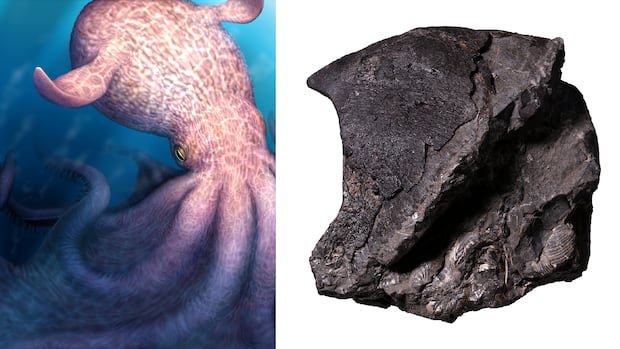
Monstrous octopuses resembling modern whales in size roamed the oceans during the Age of Dinosaurs, seizing prey with their massive tentacles and crushing them with robust jaws, according to fossils found in British Columbia and Japan. A recent study published in the journal Science reveals that these creatures, similar to mythical sea monsters like the Kraken, reached lengths of up to 19 meters, comparable to a sei whale’s size, the world’s third-largest whale species.
One of the two species identified, Nanaimotethis haggarti, could have been among the largest invertebrates ever, as stated by Yasuhiro Iba, a professor at the University of Hokkaido and the study’s senior author. Unlike the modern giant or colossal squid, which typically grows to around 12 meters, these ancient octopuses were formidable predators capable of preying on well-armored creatures based on the wear patterns observed on their fossilized beaks.
Cameron Tsujita, a paleontology professor at Western University in London, Ontario, described Nanaimotethis as “terrifyingly large,” noting the creatures’ potential to capture and crush hard-shelled prey using their large bodies and powerful jaws. This discovery challenges the notion that only marine reptiles dominated the seas during that era, suggesting that giant invertebrates like octopuses also played a significant role as top predators.
The study also revealed intriguing details about the octopuses’ behavior, such as their preference for grabbing prey on one side, indicating a level of “handedness” associated with intelligence. This finding aligns with the known intelligence of modern octopuses, highlighting the evolutionary significance of these ancient creatures.
The fossils, primarily beaks or jaws, were unearthed from rock formations in British Columbia and Hokkaido, Japan, with some specimens housed at the Courtenay and District Museum and Paleontological Centre in Courtenay, British Columbia. The discovery process involved innovative techniques like “digital fossil mining,” enabling researchers to reconstruct detailed 3D models of the ancient octopuses based on high-resolution images and comparisons with modern cephalopods.
Dating back 100-72 million years, these octopuses represent the oldest known specimens, shedding light on the evolutionary history of these enigmatic creatures. The differences between Nanaimotethis and modern octopuses pose intriguing questions about the origins and evolution of octopuses, challenging researchers to unravel the mysteries surrounding these ancient marine predators.

