
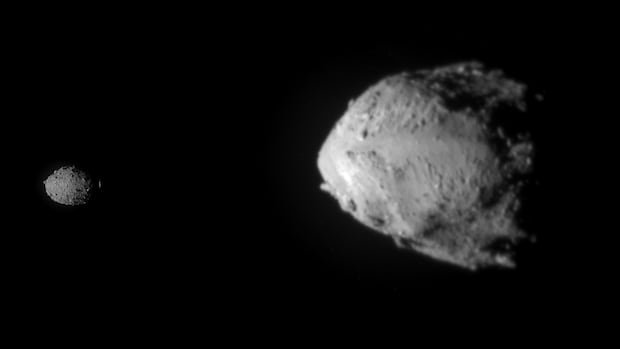
NASA’s recent mission has revealed groundbreaking evidence showcasing the potential effectiveness of deflecting asteroids. Scientists warn that the threat of a hazardous asteroid heading towards Earth could become a reality, necessitating the capability to divert it from a collision course.
Asteroids come in various sizes, leading to a wide range of impacts. These can vary from small objects creating dazzling fireballs with sonic booms to massive space rocks capable of causing catastrophic global consequences, including mass extinctions.
In 2022, NASA’s Double Asteroid Redirection Test (DART) spacecraft intentionally collided with the small moon Dimorphos, orbiting the larger asteroid Didymos, after a 10-month journey to the binary asteroid system. The successful mission, conducted approximately 11 million kilometers from Earth, revealed that the spacecraft’s impact shortened Dimorphos’s orbit around Didymos by approximately 32 minutes.
A recent study published in Science Advances unveiled an additional outcome of the collision: slightly altering the pair’s trajectory around the sun. Rahil Makadia, the lead author of the study and a planetary defense scientist from the University of Illinois Urbana-Champaign, hailed these findings as a significant advancement in safeguarding our planet.
The deliberate focus on a two-asteroid system was strategic. By targeting a binary system like Didymos and Dimorphos, scientists could more easily measure orbital changes. This system’s dynamics allowed for rapid detection of alterations, a crucial aspect in planetary defense strategies.
During the impact test, material, including rocks and boulders, was ejected from Dimorphos, demonstrating the immediate effects of the collision. Tracking the long-term impact on the system’s orbit around the sun required data collection from October 2022 to March 2025, combining radar measurements and stellar occultations for precise position tracking.
The collision resulted in a measurable slowdown in the asteroid system’s orbit around the sun, emphasizing the successful observation of a heliocentric orbit change for the first time. This breakthrough paves the way for enhanced asteroid-deflection strategies, offering a proactive approach to potential threats.
While Earth currently faces no imminent danger from asteroids, the demonstrated technology stands ready to intervene if such a threat emerges. The technology’s relevance extends to protecting both oceanic and terrestrial regions, with past impacts in Russia underscoring the importance of planetary defense measures.
The DART mission not only reshaped Dimorphos by ejecting debris but also provided invaluable insights into planning future asteroid-deflection efforts. The findings offer a blueprint for kinetic impact missions, enhancing our ability to predict and mitigate asteroid threats effectively.
In conclusion, NASA’s mission marks a significant leap forward in planetary defense capabilities, offering reassurance that humanity has the means to deflect potential asteroid threats and safeguard the Earth.

