
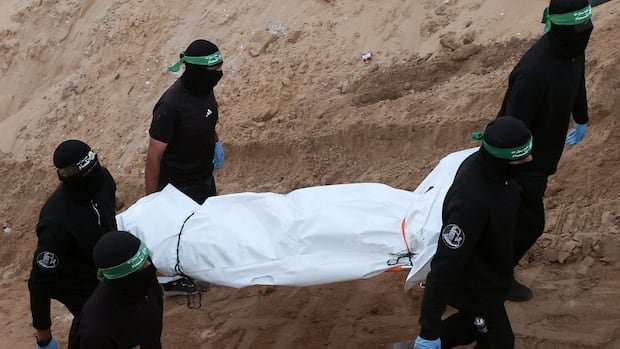
In the midst of various threats jeopardizing an already fragile Gaza ceasefire, one particularly grim issue is the exchange of deceased individuals. The current agreement involves Hamas handing over the bodies of 28 hostages to Israel in return for the remains of 360 alleged Gazan combatants.
Israel has accused Hamas of delaying the process and intentionally withholding some bodies to maintain leverage. On the other hand, Hamas attributes the delays to the extensive destruction caused by Israeli military actions. Doctors in Gaza have reported receiving Palestinian bodies from Israel with numbers instead of names, many showing signs of torture and some with bound hands.
This practice of withholding bodies persists as a bargaining tactic on both sides of the Israeli-Hamas conflict, not limited to the recent Gaza hostilities. Human rights organizations claim that Israel has stored the bodies of hundreds of alleged Palestinian militants for years, burying them in undisclosed locations known as “cemeteries of numbers.” Palestinians refer to these sites as such because the graves are identified only by numbered sticks.
According to Hussein Shejaeya of the Jerusalem Legal Aid and Human Rights Centre, Israel held the bodies of 405 Palestinians before Hamas attacks in 2023 and has added at least 330 more since then. Reports suggest that Israel may be holding the remains of up to 1,500 Gazans in morgues across the country.
Israel defends this practice as a strategic necessity, citing the hostile environment it operates in. Avi Kalo, a former head of an Israeli military intelligence unit, emphasizes the importance of treating the deceased enemies as assets to ensure the return of missing individuals. The Israeli military meticulously tracks the burial locations of these bodies for potential future exchanges.
Palestinians living under occupation view this practice as a form of oppression and collective punishment. They criticize Israel for implementing it indiscriminately across political factions, ages, and types of resistance. Families, such as that of 14-year-old Wadee Shadi Elayan, who was killed by Israeli forces, continue to seek the return of their loved ones’ bodies, facing legal obstacles and prolonged uncertainty.
While the ongoing body exchange in Gaza does not involve these cases, families affected by the practice of withholding bodies hope for closure and the opportunity to bury their deceased relatives themselves. The emotional toll and legal challenges associated with these cases highlight the deep-seated grievances and complexities surrounding the issue.

