
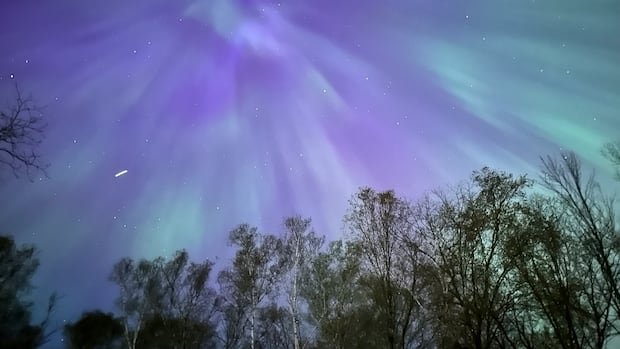
Southern Canadians have recently enjoyed vibrant displays of purples, pinks, and greens in the night sky due to heightened solar activity over the past two years. However, the northern lights spectacle will start to fade as the sun enters a calmer phase of its 11-year cycle.
The best opportunities to witness the dancing lights will continue to be in the Northwest Territories, Yukon, and Nunavut, where the auroral oval, a luminous ring encircling the magnetic poles, is most prominent. According to Ethen Sun, a Ph.D. candidate at the University of Toronto, sightings of auroras in southern Canada, including parts of Ontario, British Columbia, Saskatchewan, and Manitoba, will become less frequent as solar activity diminishes.
The sun experiences both a high-energy solar maximum and a low-activity solar minimum. Currently, we are transitioning from the maximum phase, which was about a year and a half ago, towards the minimum expected around 2031. While the sun is still fairly active, the decline has begun as we move further into the cycle.
During the solar maximum, characterized by coronal mass ejections, flares, sunspot increases, and geomagnetic storms, the northern lights shine vividly. Beyond the 60th parallel, auroras can be observed almost nightly, irrespective of solar fluctuations. The prime time to view auroras is between September and April, with particularly brilliant displays around the spring and autumn equinoxes.
Despite the auroral oval’s consistent allure, the heightened intensity witnessed in recent years may start to diminish as solar activity decreases. As Ethen Sun notes, the window for optimal viewing will gradually narrow, with peak aurora displays often associated with geomagnetic storms.
Tourism Yukon’s Market Updates for 2024 and 2025 highlight the territory’s strategic focus on leveraging the solar maximum period between 2023 and 2025 to attract tourists, with the northern lights serving as a key draw. Prominent interest in seeing the auroras comes from visitors hailing from the United Kingdom, Germany, Switzerland, and Australia.
In Yukon, the aurora also plays a vital role in driving tourism revenue, as showcased by the $484 million attributed to tourism in the region in 2025. Various tourism operators, such as Aaron Ratko of Northern Tales Travel Services, attest to the allure of the aurora as a recurring attraction for visitors across different seasons.
While Nunavut emphasizes its unique cultural and natural offerings beyond the northern lights, the territory is considering increasing its promotion of aurora experiences as the solar maximum phases out. In contrast, the Northwest Territories remains a hotspot for aurora enthusiasts, with Yellowknife boasting up to 240 nights of northern lights annually, as per government reports.
Aurora-centric businesses in the Northwest Territories, like Aurora Village, benefit significantly from the influx of visitors seeking the mystical light displays. These attractions contribute to the local economy by boosting occupancy rates in accommodations, dining establishments, and tour services.
Overall, as the sun’s activity diminishes and the three northern territories emerge as premier aurora destinations, ongoing efforts to capitalize on this natural wonder will shape tourism strategies and visitor experiences in the years to come.

