
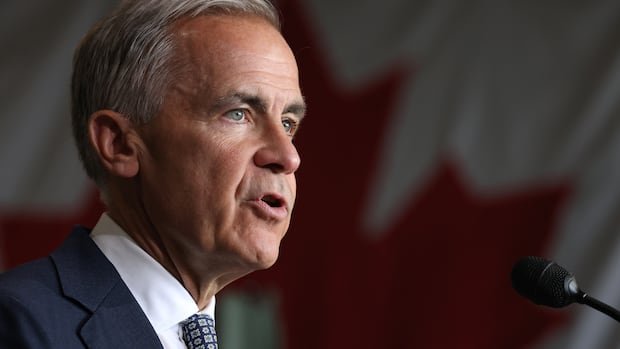
Prime Minister Mark Carney has confirmed that he had a discussion with U.S. President Donald Trump following the recent announcement of tariffs on Monday. Both leaders have agreed to escalate trade talks in response to the latest trade tensions with the United States.
Carney stated, “I had a conversation with President Trump earlier today. We have agreed to increase the pace of negotiations in the upcoming weeks, and my team and I are eager to engage in that process.”
The Prime Minister emphasized that the heightened negotiations will commence immediately, although he did not elaborate on the specific strategies his government will employ in response to the new tariffs. He indicated, “We will explore all possible options for our response if the new tariffs are implemented. This will be a key topic of discussion with provincial leaders.”
President Trump, in a statement from the Oval Office on Tuesday, expressed affinity for Canada and its people but highlighted the economic challenges the U.S. has faced due to trade relations over the past decades. He remarked, “They have been very tough on us for a long time. They rely on us for survival. Without us, they cannot sustain themselves.”
Conservative Leader Pierre Poilievre criticized the new tariffs as unjustified and pledged collaboration with the federal government to prevent their enforcement. Poilievre emphasized, “All parties must work together to avert the implementation of these tariffs. Conservatives are ready to support and defend Canada.”
The Trump administration announced on Monday evening its intention to impose a 50% tariff on a broad range of Canadian exports within 30 days. These tariffs are a response to Canada’s perceived retaliation against U.S. trade policies, particularly concerning the automotive, dairy, and alcohol industries.
The White House issued three presidential proclamations outlining the discriminatory practices it alleges Canada has engaged in, including alcohol bans imposed by most provinces following earlier U.S. tariffs on various Canadian products. These bans have reportedly led to significant declines in U.S. alcohol exports to Canada.
Prime Minister Carney emphasized that decisions regarding the removal of U.S. alcohol from Canadian stores were made by individual provinces in response to U.S. trade actions. He underscored the importance of reaching a comprehensive agreement before making any changes to these bans.
While some provincial leaders anticipate a resolution leading to the lifting of alcohol bans, others like B.C. Premier David Eby have vehemently opposed the idea. Eby emphasized the need to stand firm against perceived bullying tactics by the U.S.
Carney’s government aims to negotiate a comprehensive trade deal with the Trump administration rather than addressing trade disputes solely within the framework of the Canada-United States-Mexico Agreement (CUSMA). The goal is to ensure competitiveness across critical sectors like steel, aluminum, lumber, and the automotive industry.
In response to Carney’s statement, U.S. Trade Representative Jamieson Greer characterized the dialogue as firm yet ongoing. Greer affirmed the commitment to continued discussions with Canadian counterparts to resolve trade issues.
Canada-U.S. Trade Minister Dominic LeBlanc chaired a meeting of the government’s advisory committee on Canada–U.S. economic relations to evaluate the impact of the tariffs announcement on key sectors and to strategize Canada’s response.
Carney established this committee in April to provide expert guidance and strategic direction on Canada’s most significant trading relationship.
The ongoing discussions reflect the efforts of both countries to address trade tensions and seek mutually beneficial solutions.

