
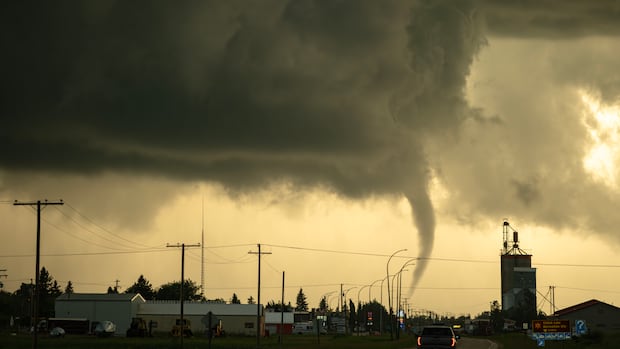
If you think there have been an overwhelming number of tornado warnings this year, you’re not alone.
Canada is on pace for what could become a record-breaking tornado season, with warnings issued by Environment and Climate Change Canada (ECCC) exceeding the actual number of tornadoes.
By July 22, the federal weather agency reported that it had issued 124 warnings nationwide, while 74 tornadoes had been confirmed to have touched down.
In contrast, ECCC sent out only 107 warnings throughout the entire previous year and recorded 116 tornado touchdowns. In 2024, the agency had issued 100 warnings and documented 132 tornadoes.
The agency shared data with CBC News dating back to 2017, revealing that this year has already seen the highest number of alerts to date.
ECCC’s tornado warnings have risen sharply over the last decade. For instance, in 2018, only 34 warnings were issued, resulting in 105 tornadoes touching down.
A representative explained via email that the number of warnings might occasionally be fewer than the number of tornadoes that occur “even if they were perfectly forecasted,” since multiple tornadoes can develop in a single event, leading to just one warning being issued for the area affected.
No additional comments on the statistics were provided by ECCC by the time of the deadline.
‘You can’t be dithering’
This increase is welcomed by David Sills, director of Western University’s Northern Tornadoes Project (NTP) based in London, Ontario, which monitors tornado activity across Canada and dispatches teams to assess damage.
<p"Certainly, there can be instances of false alarms with these warnings, but that’s a trade-off: you either increase the number of warnings and accept a few more false alarms, or you risk missing tornadoes altogether," Sills stated.
NTP issued a failing “report card” for ECCC’s warning system in 2022, based on data from 2019 to 2021, which indicated that the agency was overlooking tornadoes and not meeting its warning targets in terms of both frequency and timing.
-
2 central Alberta tornadoes confirmed as ‘significant’ EF-2 twisters as active season continues
-
‘Just dumbfounding’: Tornado damages buildings, homes in central Alberta county
“I understand that many forecasters find this challenging. They dislike issuing false alarms,” Sills stated. “However, if you want to provide advanced notice with these events, rapid decision-making is essential… You can’t afford to hesitate when issuing a tornado warning.”
According to Sills, this year has marked the busiest period for his team since the project’s inception in 2017, with projections indicating a record number of tornadoes across Canada. NTP has tracked 83 tornadoes so far in 2026, with 70 of those occurring in Alberta, Saskatchewan, and Manitoba.
Concerns of ‘warning fatigue’
However, Greg Johnson, a storm chaser from Regina, expresses skepticism about the volume of warnings.
“I’ve witnessed storms that have zero potential to produce a tornado. I receive alerts on my phone while standing right there, thinking there is no reason this should be tornado-warned,” he stated.
Johnson argues that part of the issue stems from warnings being issued over such broad areas that individuals far removed from the storm, who cannot even see it, receive them.
He fears that excessive alerts for storms that pose no real threat will lead to “warning fatigue” among the public.
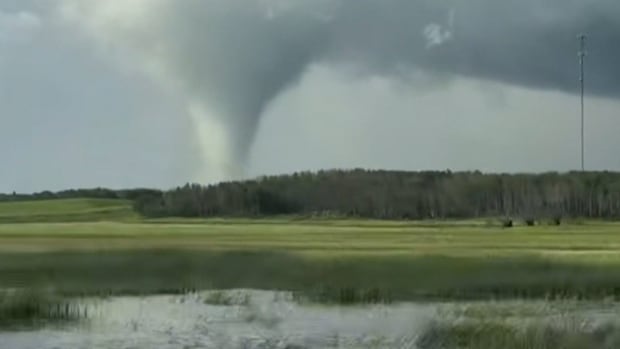
There have already been 83 confirmed tornadoes in Canada this season, with 70 of them in Alberta, Saskatchewan and Manitoba. This is partly due to the summer’s weather but Environment Canada says it’s also because of improved tracking efforts.
“If you’re inundated with warnings every day and no tornadoes appear, the next time a warning comes through, you might think, ‘Well, I’m not changing my plans because of this silly alert. I get these all the time,'” he remarked.
Johnson acknowledges that forecasters want to avoid missing tornado occurrences, but believes there needs to be a “balanced approach.”
Forecasting a challenge: ECCC
Meteorologists utilize computer modeling and Doppler radar to monitor and predict storm activity.
An ECCC representative mentioned that predicting tornadoes is particularly challenging, as only 20 percent of severe thunderstorms produce tornadoes. Instead of directly detecting most tornadoes, radar is employed to analyze the thunderstorm’s structure and wind patterns to assess whether the conditions are right for a tornado.
Experts told CBC News that forecasting tends to be more accurate in the U.S., where tornado frequency is higher, populations are denser, and more forecasters monitor radar systems.
Peter Kimbell, a warning preparedness meteorologist at ECCC, shared with CBC’s Ottawa Morning that enhancements to the current system are underway.
-
CBC Explains
How has tornado forecasting technology changed over time?
-
Possible tornado rips through Harrington Que., in the Laurentians
ECCC forecasters in Toronto determine when to issue tornado alerts through Canada’s Alert Ready system, and Kimbell noted that the technology can sometimes lag behind, which may lead forecasters to issue warnings covering a larger area than the immediate threat zone.
“So there may be some instances of over-warning occurring now, but 20, 30, or 40 years ago, we couldn’t even do that, and the risk was that many people didn’t receive the warning at all,” he concluded.

