
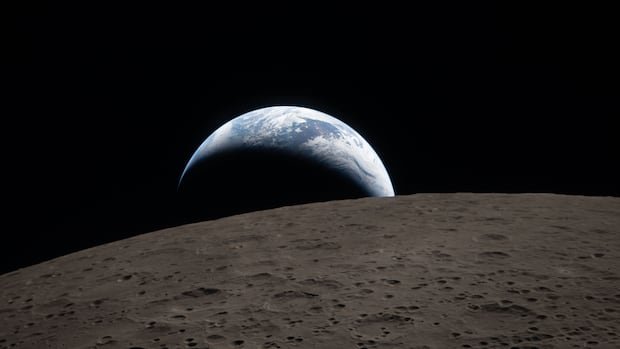
NASA is pursuing an ambitious goal known as a “moonshot,” defined as a plan to achieve something nearly impossible. Initially, this term referred to the successful moon landing by NASA in the 1960s. Currently, NASA is focused on a new moonshot: returning astronauts to the moon’s surface.
The challenge lies not in the impossibility of the task itself but in the timeline set by NASA. The space agency aims to land astronauts on the lunar surface in early 2028, a mere 24 months away. Despite contracting lunar landers to Blue Origin and SpaceX, both companies have yet to produce a final product publicly.
SpaceX has been conducting tests on its Starship rocket, a crucial component for transporting astronauts to the moon, showing some progress but not yet reaching readiness. Without a functional lunar lander, a lunar mission remains unattainable.
Given NASA’s history of delays, doubts arise about its ability to meet the 2028 deadline. Previous plans, such as the Artemis II mission, faced delays due to cost overruns. Notably, NASA has a track record of missing deadlines for ambitious projects like the space shuttle and the International Space Station.
NASA recently announced a shift in its Artemis program, delaying the crewed lunar mission to 2028 with Artemis IV. However, the absence of ready lunar landers poses a significant hurdle. SpaceX’s Starship, intended for the lunar landing, has not yet reached orbit, and Blue Origin encountered setbacks in a recent rocket launch.
Experts express skepticism about NASA’s timeline, emphasizing the time required for lunar lander development. Challenges with spacesuit development and the cancellation of the Lunar Gateway further complicate the mission’s feasibility.
To refuel in space, both Blue Origin and SpaceX landers must undergo complex preparations, involving multiple tanker launches. The intricate process highlights the significant technical hurdles facing the mission.
Despite NASA’s ambitious timeline, numerous obstacles, including untested landers and refueling procedures, cast doubt on the feasibility of the 2028 mission. The race to the moon against China, set for 2032, adds further pressure on NASA to expedite its lunar ambitions.

