
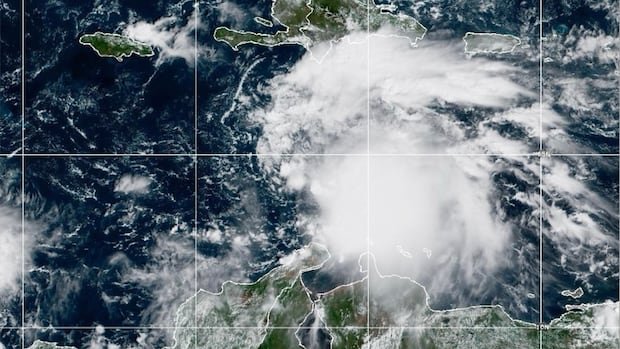
Tropical Storm Melissa moved slowly through the Caribbean Sea on Thursday, posing a threat of hazardous landslides and potentially life-threatening flooding to Jamaica and southern Hispaniola, which is a shared island between the Dominican Republic and Haiti. In southern Haiti, the storm was linked to a fatal incident where a large tree fell, killing an elderly man in Marigot, while five others sustained injuries due to flooding in the central Artibonite area, as reported by the Civil Protection Agency.
Authorities advised residents living in flood-prone areas to relocate to higher ground. The storm, with maximum sustained winds of 80 km/h, was located approximately 345 kilometers southeast of Kingston, Jamaica, and 440 kilometers southwest of Port-au-Prince, Haiti. It was moving northwest at a speed of 7 km/h, according to the U.S. National Hurricane Center in Miami.
A hurricane watch was issued for Jamaica and the southwestern peninsula of Haiti from the Dominican Republic border to Port-au-Prince, while a tropical storm warning was in effect for Jamaica. The storm’s slow and erratic movement raised concerns, with forecasts indicating that Melissa was expected to strengthen significantly by late Friday and over the weekend.
Barbara Campbell, a resident of Kingston, Jamaica, shared her concerns about the approaching storm, mentioning that she had taken precautions by securing her home and stocking up on essential supplies. In anticipation of the storm’s impact, Jamaican officials announced the availability of 881 shelters if needed, with court closures and schools transitioning to remote learning on Thursday. Additionally, preventative measures, such as the placement of 1,000 sandbags in eastern Kingston, were undertaken to mitigate potential flooding risks.
Evan Thompson, the director of Jamaica’s Met Service, highlighted the potential for up to 30 centimeters of rainfall in the island’s eastern region, emphasizing the significance of being prepared for substantial precipitation. In the Dominican Republic, numerous individuals sought refuge in shelters, and various establishments remained closed in nine provinces under alert status. Officials stressed the importance of staying indoors for safety reasons.
Concerns were particularly high for Haiti, given its vulnerability to natural disasters due to factors such as environmental degradation, gang violence, poverty, and weak governance. The UN Office for the Co-ordination of Humanitarian Affairs allocated $4 million US to assist over 10,000 vulnerable individuals in Haiti with evacuation support, emergency shelter management, and other essential supplies.
Melissa marked the 13th named storm of the Atlantic hurricane season and was the first storm to develop in the Caribbean this year. The U.S. National Oceanic and Atmospheric Administration’s forecast predicted an above-average season with 13 to 18 named storms, including five to nine hurricanes, with two to five potentially becoming major hurricanes. The Atlantic hurricane season spans from June 1 to November 30.

